A
s it would be impossible for us to render in but a few words a detailed account of the Great Rebellion, led by Tupac Amaru II and the participation of his wife and his relatives, we have made use of articles and visual materials published by Peruvian scholars to tell this chapter of our history.
During the fifteenth, sixteenth, and seventeenth centuries, Spain held a vast territorial domain in the Americas. Through its power, Spain was able to consolidate its existence as an empire. Spain’s abuse of such power led to the first and most important social protest during its colonial rule. This movement ended with the execution of Tupac Amaru II, his wife, his children, and his relatives, and a campaign of terror and torture to prevent further uprisings. Nevertheless, the seeds of emancipation had been planted throughout Spanish America.
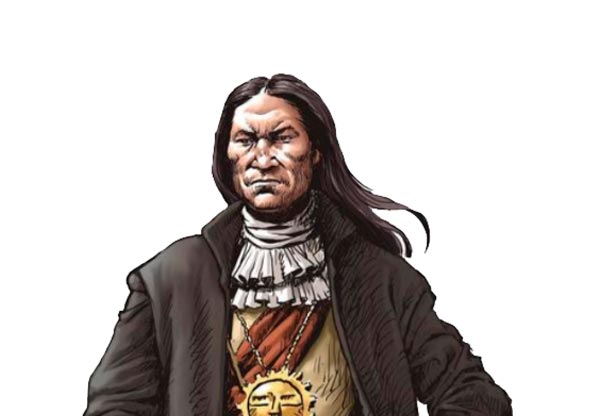
José Gabriel Condorcanqui or Tupac Amaru II (Resplendent Serpent in Quechua) was the leader of mestizo origin who led the most important rebellion in the Vice-Royalty of Peru. He was the son of the chief Miguel Condorcanqui Usquiconsa and a descendant of Tupac Amaru I, the last Inca Sapa of the Vilcabamba resistance. Tupac Amaru II was born in Surimana-Canas, Cuzco on March 19, 1738 and he was educated at the Jesuit school of San Francisco de Borja.
Later, he attended art classes at the Universidad Mayor de San Marcos and became fluent in Latin, Quechua, and Spanish. Tupac Amaru II inherited on an interim bases the chiefdoms of Pampamarca, Surimana, and Tungasuca and enough mules to devote himself to the transportation of goods throughout the different communities. While engaged in this enterprise, he learned about the mistreatment that the Spaniards were committing against the indigenous people. Thus, he met future adherence to the cause of the Great Rebellion.